Category: United States
Urban Ag
A short video from Community Alliance with Family Farmers about what urban farmers would like from the U.S. Department of Agriculture.
I noticed a couple of small things…
- Mention of a farm ID. What’s a farm ID?
- One of the farmers is in Long Beach, not so far from me. It would be cool to work with her.
- ALL farmers complain about the paperwork and reporting requirements for grants from the USDA, but it’s rougher for small farmers who don’t have farm managers or accountants on staff. I’ve heard slaughterhouses complain, too. The paperwork requirements, inspections, safety protocols etc. are all largely written with the help of lobbyists who represent large farming interests, and they can easily turn out to be barriers rather than benefits for the little guys.
Note to me: The small farmer in Long Beach was Sasha Kanno of Farm Lot 59.
Federal Farm Policy-AFT
Free Range Conversations from American Farmland Trust (AFT) talks about federal farm policy.
- Host: Greg Plotkin, Digital Communications Manager, AFT
- Guest: Tim Fink, Policy Director, AFT
- Emily Liss, a Federal Policy Associate, AFT
Streamed live on Jan 21, 2021
AFT’s 2021 Transition Recommendations:
- Develop a USDA Cover Crop Initiative
- Establish a Commission on Farm Transitions
- Maximize the Economic and Environmental Benefits of ACEP-ALE
- Strengthening the Farmland Protection Policy Act
- Create a Debt for Working Lands Initiative
What’s the Beef?
Slow Food USA is offering a free, online panel discussion about meat that it’s framing as a way to begin talking about the 2023 Farm Bill.
Join us to examine the impacts of industrial-scale livestock production. We’ll hear perspectives from small-scale farmers and ranchers, humane animal husbandry, regenerative environmental practices, climate impact, and meat and poultry workers. This will serve as a launch point for the 2023 Farm Bill discussions. We’ll focus on Representative Pingree’s Agriculture Resilience Act (ARA) and Senator Booker’s Farm System Reform Act. After our conversation, we’ll give you simple steps to call your legislators to support the bills. This panel is curated by our National Food and Farm Policy committee.
https://slowfoodusa.org/slow-food-live/
A Slow Meat Panel with Matthew Raiford, Wednesday, February 10, 11am PST/2pm EST
Progress Report-US
The whole point of this blog is that it’s a work in progress. Here’s my progreess so far on US policy. (Eventually I’ll get around to California and local policy.) First, I’m specifically interested in food production as it relates to climate. There are two federal bodies that deal primarily with food, the Department of Agriculture (USDA) and the Food and Drug Administration (FDA). Only the first deals with issues that relate to climate, so I’ll be giving the FDA short shrift.
Legislation
- Farm Bill – Passed roughly every five years, it’s the primary enabling legislation.
- A trio of antitrust laws that seem ancient but are still very relevant given that the astonishing level of concentration in food production is seen by many as a problem:
- Sherman Antitrust Act (1890)
- Clayton Antitrust Act (1914)
- Packers & Stockyards Act (P&SA, 1921)
Government Entities
- President – Sets policy and appoints the Secretary of Agriculture, who heads the DOA.
- Department of Agriculture – Administers the Farm Bill
- Legislative Ag Committees
Special Interests
I haven’t got very far with interest groups, but my sense is that there are lots of lobbyists and most of them are representing large business interests, not people whose only interest in food is eating it, or small farmers, or the rural communities that depend on farming. I see that as a problem. Open Secrets looks like a great site for getting up to speed on lobbyists. I’m sure I’ll be looking to if for help later.
That’s it for now, but I hope, in time, to expand all this… a LOT.
Agriculture Resilience Act
This bill, introduced by Chellie Pingree, is dead this session, but bills that fail aren’t necessarily gone. They can be reintroduced, sometimes modified in ways that make them more passable. The National Sustainable Agriculture Coalition considers the bill one of the good things that happened in agriculture in 2020, so it’s something I’d like to look into when I’ve recovered from the holidays. Consider this post a tip or a placeholder. Here are a few links…
Nuts and bolts info from GovTrak
RFD TV did a story on the bill, in which they mention a white paper by the Rodale Institute. The paper says regenerative agriculture could sequester ALL of our annual carbon emissions.
Urban-Rural Divide
Worth a read: Why Democrats Keep Losing Rural Counties Like Mine, by Bill Hogseth, chair of the Dunn County Democratic Party in Wisconsin, in Politico, 12/01/2020.
He details how consolidation in the food industry — that is, big companies buying out smaller ones and then moving on to consume each other — is devastating farmers and farming communities in the United States, and how the Democratic party isn’t helping.
“Farmers’ share of every retail food dollar has fallen from
about 50 percent in 1952 to 15 percent today. Corporations control more and more of the agriculture business…”
Antitrust action is a priority for rural voters, but the Democratic Party doesn’t seem to get it. Obama said the right things but didn’t follow through. “His Department of Agriculture balked when it came time to enforce anti-monopoly rules such as those in the Packers and Stockyard Act…”
Now Biden, is saying the right things, too. “In his rural plan, Biden pledged to ‘strengthen antitrust enforcement,’ but the term doesn’t appear until the 35th bullet point. For rural voters, antitrust enforcement is a top priority.” And shortly after publication of Hogseth’s piece, Biden announced his pick for Secretary of Agriculture — Vilsack, former secretary of agriculture under Obama.
“But my hope,” say Hogseth, “is for Democrats to listen to and learn from the experiences of rural people.”
For new readers…
This is a quick and dirty foray into food policy for climate activists, especially in the USA and California. I like to bounce ideas off other people, so, welcome! Add thoughts, add resources, it’s all good. I expect order to emerge from the welter but it could take a while. Hang in there. 🙂
Big Ag and Antitrust, a Conference
Yale law school is offering a free online conference on January 16, 2021, “Big Ag & Antitrust: Competition Policy for a Sustainable and Humane Food System,” 6 am (ouch!) to 2 pm. I’m signed up! Six am is early, but it’s better than the event I attended that was set in Europe.
Bill Bullard, the CEO of R-CALF USA, has been invited to present a paper updating a 2013 publication of his in The South Dakota Law Review, Under Siege: The U.S. Live Cattle Industry. Reading it could give you a taste of what the conference is about — or perhaps a hearty meal. It’s 51 dense pages with footnotes. Here’s the abstract:
Although the largest U.S. agricultural sector—the live cattle industry—is
still comprised of hundreds of thousands of independent producers, it is
currently on a trajectory to become a vertically integrated supply chain
controlled by just a handful of dominant meatpackers. This is the fate already
suffered by the nation’s hog and poultry industries within which once
competitive markets have been replaced with corporate command and control
and opportunities for independent livestock businesses have largely disappeared.
Only by renewing the nation’s long lost appetite for antitrust enforcement and
other legal actions to preserve livestock market competition can the ailing cattle
industry be revitalized for future generations.
Vilsack
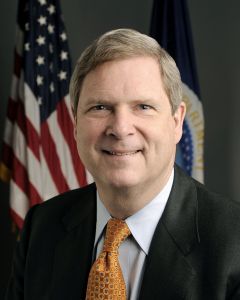 Tom Vilsack is Biden’s pick for Agriculture Secretary according to Politico, though a formal announcement hasn’t been made yet. Vilsack has already served in that role under Obama, and advised on rural and agriculture policy during Biden’s campaign.
He is definitely not a wild-eyed reformer. I suppose that means he’d be easier to get confirmed, easier for everyone in Washington to work with, and completely unlikely to curb Big Ag in any serious way.
This 2012 article in the Washington Monthly was brought up in an online farming group to remind people of who Vilsack is. It’s long. In brief, it details how anti-trust laws were reinterpreted during the Reagan era to make it easier for large companies to buy each other out. One result was growing concentration in agriculture, to the detriment of small, independent farmers. This has been a tremendous change and is ongoing. During Vilsack’s tenure as Obama’s Secretary of Agriculture, he led a doomed effort to reign in the power of Big Ag.
By November 2011, it was clear that the reformers had lost. … The most ambitious, far-reaching campaign to reform the agricultural industry in forty years was over, less than two years after it had begun.
Obama’s Game of Chicken
If it’s major reform we’re looking for (I am), Vilsack is probably not the best person to count on. And, by the way, David Scott, the new chair of the House Agriculture Committee, is also mentioned unflatteringly in the Washington Monthly article as one of a group who opposed the reforms.
 City Farm Policy